 Aero Academic
Aero Academic
Aero Academic
Australia publishes its aeronautical information as one package made of several documents. The AIP Book holds permanent national information, ERSA lists aerodromes and facilities, DAP carries terminal procedure charts, the DAH describes airspace, and NOTAM, AIP Supplements and AICs carry changes and notices. Knowing which one answers your question saves time and prevents mistakes.
Checked against: AIP Australia Amendment 129, GEN 3.1 (Aeronautical Information Services), GEN 3.2 (Aeronautical Charts) and AD 1.1, and the ERSA Introduction effective 26 NOV 2026 (published ahead of that date).
| Part | What it is | How it changes | Check it for |
|---|---|---|---|
| AIP Book (GEN, ENR, AD) | The basic document for permanent information and long-duration changes | Amendments, normally in line with the AIRAC cycle | Rules, definitions, services, tables, abbreviations, airspace structure |
| ERSA | Aerodrome and facility directory | Reissued on a 13 week cycle | Runways, lighting, frequencies, services, local procedures |
| DAP | Departure and Approach Procedures | Amended on the AIP cycle, changes noted in chart margins | Instrument approach and departure charts |
| DAH | Designated Airspace Handbook | Issued as a separate complete product, normally twice a year | Airspace designations and dimensions |
| Charts | Maps and aeronautical charts | Updated by AIP amendment on published dates | Navigation, terminal and en route charts |
| AIP Supplement (SUP) | Temporary changes of three months or longer, or extensive short-term material | Distributed online with a trigger NOTAM | Long temporary changes with text or graphics |
| NOTAM | Rapid notice of information of direct operational significance | Issued as needed | Closures, outages, hazards, temporary restrictions |
| AIC | Aeronautical Information Circular | Checklist issued monthly | Administrative information that does not qualify for AIP or NOTAM |
AIP Australia GEN 3.1 describes the Integrated Aeronautical Information Package as the AIP, AIP amendments, AIP Supplements, NOTAM and pre-flight information bulletins, and Aeronautical Information Circulars. The AIP itself is published in several forms: the AIP Book, the Departure and Approach Procedures, the En Route Supplement Australia, the Designated Airspace Handbook and maps and charts.
That sentence is worth remembering because exam questions often ask which document carries a given item. If you hold the structure in your head, you can answer by role rather than by trying to recall a page number. Table 1 gives the roles in one place.
The AIP Book is split into three parts. Part 1 is General (GEN) and covers national regulations and requirements, tables and codes, and services. Part 2 is En Route (ENR) and covers general rules and procedures, air traffic services airspace, ATS routes, radio navigation aids and systems, navigation warnings and en route charts. Part 3 is Aerodromes (AD) and covers the introduction to aerodromes and heliports, aerodromes and heliports.
The AIP is described as the basic document intended to satisfy international requirements for the exchange of permanent aeronautical information and long-duration temporary changes essential for air navigation. In practice, you meet it for definitions and abbreviations in GEN 2.2, for the services you can expect in GEN 3, and for the rules about airspace and procedures in ENR.
AD 1.1 is the bridge to ERSA. It states that the aerodrome directory is published as ERSA FAC, listing certified aerodromes along with their availability and conditions of use, and that details of uncertified aerodromes and helicopter landing sites are included when the aerodrome operator requests it. It also puts the responsibility for obtaining current information about an uncertified location on pilots and air operators.
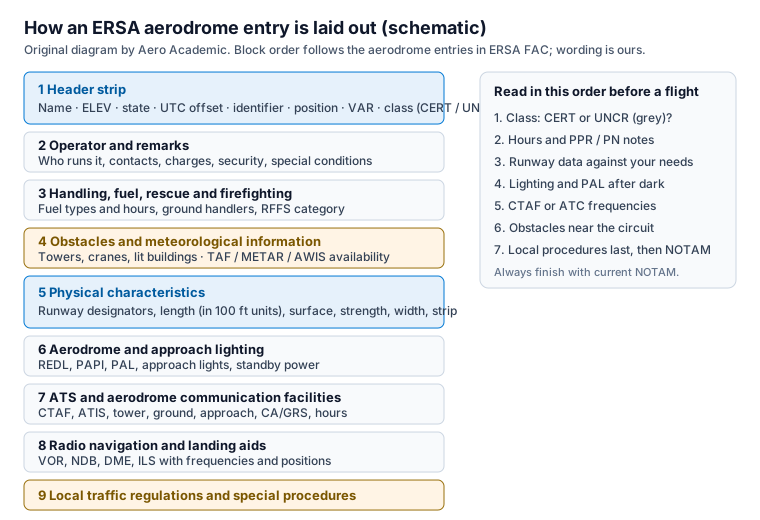
ERSA is where you go for the specifics of a place: its runways, lighting, services, radio frequencies and local rules. It is reissued on a 13 week cycle, which is why each edition has a clear effective date. Our companion guides explain how an entry is laid out and how to decode its abbreviations.
ERSA also carries a legend section that is a useful study resource in its own right, because it explains codes that appear across aviation documents. Many candidates are surprised that the legend answers questions they assumed were about regulations.
Departure and Approach Procedures is the AIP volume for terminal procedure charts. ERSA aerodrome entries commonly include a line under charts related to the aerodrome that refers you to AIP Departure and Approach Procedures. If you fly instrument procedures, DAP is the working document, and the changes to a chart are advised in the chart margin.
The Designated Airspace Handbook is the reference for designated airspace. The AIP states that amendments to the DAH and ERSA are issued as separate complete products, and that the DAH and maps and charts other than the world aeronautical chart are normally amended biannually, around May and November.
NOTAM supplements the AIP and gives rapid distribution of information of direct operational significance. For domestic distribution the AIP describes a B series for ATS category NOTAM and a C series for all other categories. A checklist of valid NOTAM is issued monthly, and it also identifies the elements of the AIP effective on that date.
AIP Supplements carry temporary changes of long duration, three months or longer, and short-duration information that consists of extensive text or graphics. They are distributed through the Airservices website with an associated trigger NOTAM that is valid for 14 days. Operationally significant temporary changes follow the AIRAC system and are marked as AIRAC AIP SUP.
An Aeronautical Information Circular is used for administrative information that does not qualify for the AIP or for NOTAM. It is the document to think of when information is useful but not operationally urgent, and a checklist of current AIC is issued monthly.
AIRAC stands for Aeronautical Information Regulation and Control. GEN 3.1 explains that operationally significant changes that require amendments to charts and route listings are generally issued on predetermined dates so that users can plan for them. Information is issued so that users receive it not later than 28 days before the effective date, and in major cases 56 days of notice may be given.
AIRAC documents and charts become effective at 1600 hours UTC on the day before the nominated date unless otherwise notified. At each effective date a Head Office trigger NOTAM identifies the elements of the AIP effective on that date and their effective dates. The 2026 effective dates in the AIP table are spaced four weeks apart, from 22 January through to 24 December.
The practical point is that the edition you hold may be published ahead of the date it takes effect. When you read a date on a page, ask whether it is the published date or the effective date, and check which is in force on the day you fly.
Start with the question you are asking. If you want to know what an aerodrome is like, use ERSA. If you want to know how to fly a procedure, use DAP. If you want a rule, a definition or a table, use the AIP Book. If you want to know what is different today, read NOTAM, and check AIP Supplements for any long-running change.
Then close the loop by checking the date. ERSA, the AIP and DAP all carry effective dates, NOTAM carries validity times, and AIP Supplements carry their own dates and a trigger NOTAM. A good flight planning habit is to note the edition or amendment you used on your flight log, as a reminder that the information has a date.
Imagine you are planning a daylight flight to an aerodrome you have never visited. You open the AIP Book first to refresh the airspace rules that apply to the class of airspace you expect near the field. You then open the ERSA entry for the aerodrome and read the classification, the hours, the runway data and the radio frequencies. You note that the entry points to Departure and Approach Procedures, which you only need if you plan an instrument arrival.
The night before the flight you check NOTAM for the departure aerodrome, the destination and the route, and you scan the AIP Supplement checklist for any long-running change such as a temporary restriction. On the morning of the flight you check the weather, and you write the edition dates on your flight log. Nothing in that sequence is surprising: it is simply each document doing its job in turn.
Candidates often say ERSA contains approach charts, or that it is the part of the AIP Book that deals with aerodromes. It is a separate volume, and the approach charts are in DAP. Another common error is assuming NOTAM replaces the AIP, when it supplements it and is replaced in time by an amendment or supplement.
A third mistake is to quote the wrong body. ERSA, the AIP, DAP and the DAH are Airservices Australia publications. CASA regulates, and its documents include the CASRs, the Manuals of Standards and advisory material. Keeping the publisher straight helps with questions about who is responsible for a piece of information.
Yes. AIP Australia lists ERSA as one of the forms in which the AIP is published, alongside the AIP Book, DAP, the DAH and maps and charts.
NOTAM gives rapid notice of information of direct operational significance. An AIP Supplement carries temporary changes of three months or longer, or short-term information with extensive text or graphics, and is distributed with a trigger NOTAM.
Aeronautical Information Regulation and Control. It is the system that issues operationally significant changes on predetermined effective dates so users can prepare.
In the Departure and Approach Procedures (DAP). ERSA entries refer you there rather than reproducing the charts.
Airservices Australia, through its Aeronautical Information Service. CASA is the regulator and publishes the regulations and Manuals of Standards.
https://www.aeroacademic.com.au/guides/ersa-vs-aip-vs-dap